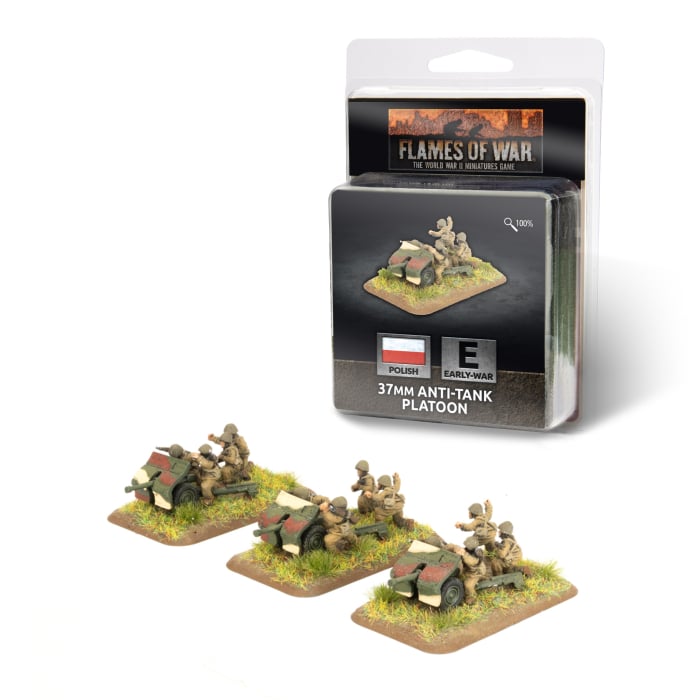

37mm Anti-tank Platoon
- The Bofors 37mm wz.36 anti-tank gun provides Polish infantry units with some punch
- This small gun is capable of penetrating any German armour but is best used to protect your infantry rather than entering into a head to head gun fight

76mm Field Gun
- Each infantry regiment has a small infantry gun platoon that fields a pair of 75mm wz.02/26 field guns
- Older than most of the crews serving them, these simple, hardy guns are re-chambered Russian 3-inch guns that had originally fought under the Tsar before being captured from the Red Army
- However, in 1926 they were modernised to take the same French 75mm ammunition as the 75mm wz.1897 field guns

7TP Tank Platoon
- The 7TP (meaning 7-Ton, Polish—weighing in at nearly 10 tons) light tank was a locally-produced, diesel-engined version of the British Vickers E. Like the Vickers E, the first 40 completed were armed with twin wz. 30 machinegun turrets (labelled dw from dwuwieżowy or twin turret), while the final 95 had a single turret armed with the excellent Bofors 37mm wz. 37 gun (labelled jw from jednowieżowy or single turret)
- The 7TP was an effective tank, but there were simply not enough of them to make a difference to the eventual outcome of the invasion

Machine-Gun Platoon
- Each infantry battalion has a company of heavy machine-guns
- Normally each company is assigned a platoon of three Ckm 7.92mm wz.30 heavy machine-guns, while the fourth platoon remained at the battalion commander’s disposal
- Poland adopted the water-cooled Browning .30 cal M1917 heavy machine-gun in 1930 as the Ckm wz.30 and aside from changing the design to metric for manufacture in Europe, they also changed the calibre to 7.92mm to match their rifle ammunition

Rifle Company HQ
- The Polish Army began the war on 1 September 1939 with thirty regular infantry divisions, just over half the number they faced in the German Army
- Despite being outnumbered and largely lacking tank support, the Polish Army fought hard throughout the campaign
- The Polish rifle company is an unusually strong formation with 232 officers and men, nearly 50% larger than its German counterpart

Rifle Platoon
- Each of a Rifle Company’s three rifle platoons has three 19-man sections
- With just a single wz. 28 automatic rifle (a licensed copy of the American Browning Automatic Rifle) in each 19-man squad, the main firepower of a platoon comes from its riflemen
- These are armed with the Mauser Karabin wz. 98a, the same weapon as their German counterparts