
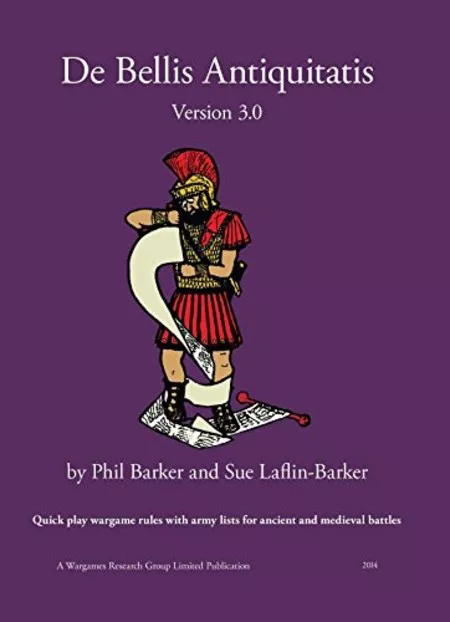
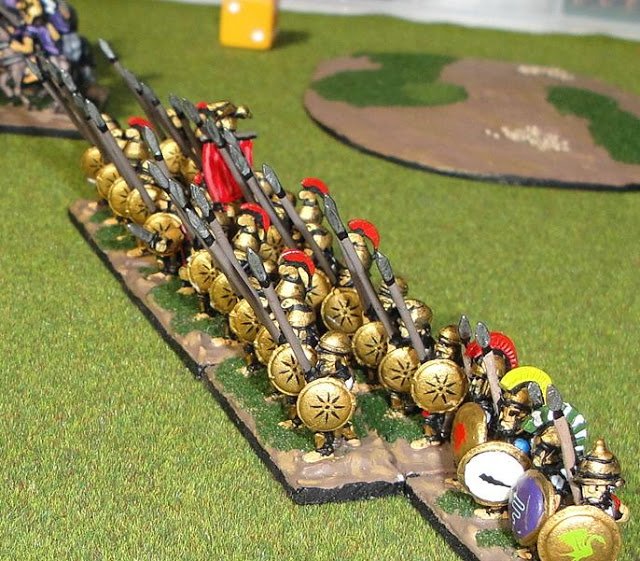
De Bellis Antiquitatis or DBA (English: Of the Wars of Antiquity) is a fast play set of rules for the hobby of historical miniature wargaming, particularly ancient and medieval wargaming in the period 3000 BC to 1520 AD. These rules allow entire armies to be represented by fewer than 50 figures. The rules also include diagrams and over 600 army lists. DBA is produced by the Wargames Research Group and was the first game in the DBx series, which now includes De Bellis Multitudinis (DBM), De Bellis Magistrorum Militum (DBMM, a successor or alternative to DBM), Hordes of the Things (a fantasy version), De Bellis Renationis (DBR, a Renaissance version), and Horse Foot and Guns (HFG covering 1700-1920). An online video game titled DBA Online was also created.
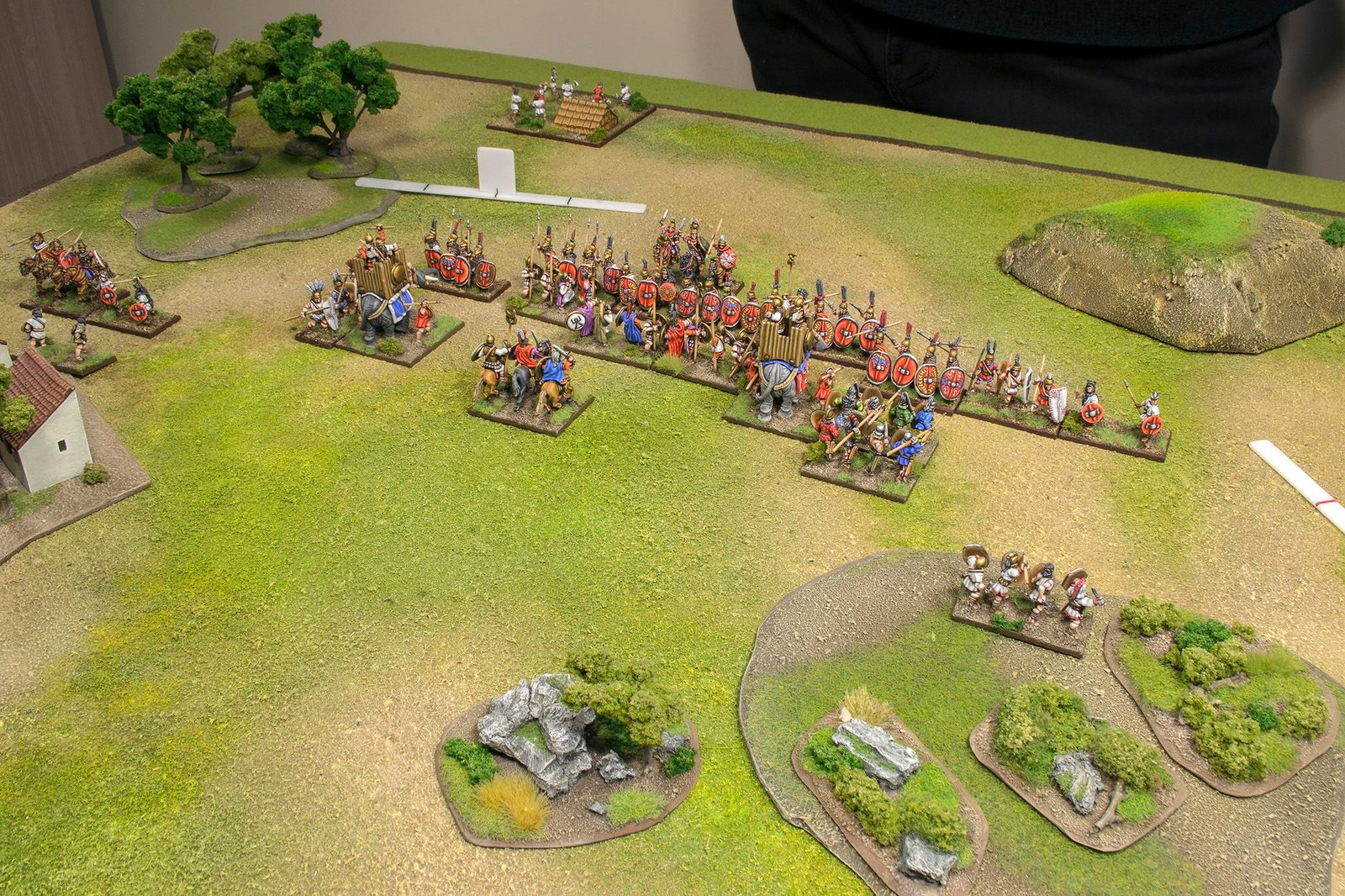
Scale: Each army is composed of 12 elements (stands), with several figures fixed upon each one. The number of men represented by an element varies according to the size of the army simulated and the number of figures that it has, but at a nominal ground it would be more or less 250 for each figure. Ground scale is 1″ = 100 paces for 15 mm figures or smaller, 40 mm = 100 paces for 25/28 mm figures. One turn, called a bound in the rules, represents 15 minutes. Can be used with 25/28 mm, 15 mm, 6 mm, or 2 mm figures (54mm and larger a possible with increased base size).
Players use a single six-sided die each, and games are played on a square field, which conventionally (though not necessarily) has sides that are roughly sixteen times the base width being used.
Though the exact details differ in different editions of the game, in the current version players roll dice to determine who will be the invader and who will be the defender. The defender uses a random process to place terrain according to his army’s home territory, and the invader chooses which side his army will enter the board. The players then alternate in placing their camp model and armies, and the defender takes the first bound.
Players then alternate bounds. At the start of each bound, the active player dices for “PIPs”. PIPs are the spots on a die. The number of PIPs rolled represents the player’s level of control for the turn. Players spend their PIPs to move single elements or connected groups of elements on the game board. PIPs do not carry over from turn to turn. PIPs simulate (though not model) the difficulties of command and control during a battle, and players find that once battle is joined, they often need to spend all of their available PIPs shoring up their battle line, with few PIPs left over for maneuver of un-engaged elements.
After making any such desired moves, the players then conduct combat, both ranged and close combat, adjudicated in the order specified by the active player.
Combat is resolved per-element, in the order desired by the active player. To resolve combat, each player throws one die and adds modifiers for both troop type and battlefield situation (such as being outflanked or up hill). The higher roll wins the combat and results are applied immediately, before the next combat is decided. Achieving a roll twice as high as your opponent generally destroys that opponent, with lesser successes merely pushing the opponent back out of the line of battle. Note that since results are applied immediately, shrewd players resolve combats whose results can give them advantages against other elements in future combats.
Once all combats have been resolved, the other player takes their turn. The game continues in this way until one of the players achieves the win condition – the destruction of 1/3 of the enemy’s army. In the event of a tie at the end of bound, play continues until the end of a bound where one player has lost more than the opponent.
Other versions include
Reddit: Debellisantiquitatis Subreddit
Youtube: DBA 3.0 Rules Review by Medieval Wargamer
Youtube: DBA Review by Lace and Steel
Youtube DBA Playlist (230 Videos) by Tony Aguilar Figure-atively Speaking