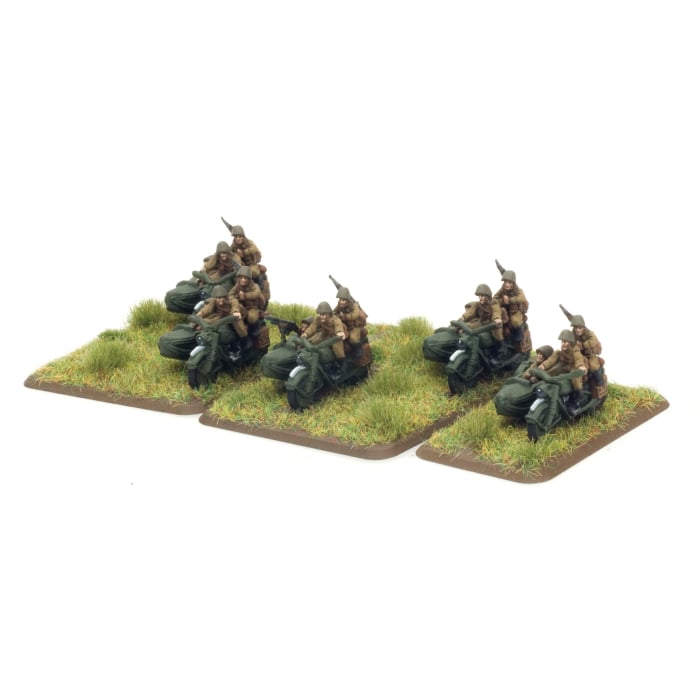

Zmotoryzowanej Motorcycle Squad
- Each motorised regiment and the brigade’s reconnaissance group have a motorcyclist platoon with (at least in theory) six reconnaissance groups. In the Warsaw Armoured-Motorised Brigade the motorcyclists operate with the tankette platoons as a mobile strike force able to move from crisis point to crisis point as needed

Wz.34 Armoured Car Platoon
- Each cavalry brigade has an armoured battalion which includes a company of eight armoured cars. In ten of the eleven Polish cavalry brigades the armoured car used was the wz.34
- The wz.34 was a further development of the earlier half-tracked wz.25 armoured car, subsituting the tracked rear drive for the simpler and faster wheeled rear drive. It could be armed with either a 37mm Puteaux SA18 cannon or a Hotchkiss 7.92mm machine-gun

Polish Armoured Train
- The history of Polish armoured trains started shortly after Poland gained independence in 1918
- They were one of the most important weapons in the war against Bolsheviks in 1919 and 1920, and the other conflicts that shaped the borders of Poland

Polish 155mm wz.17 gun
- The 155mm wz. 17 was the Polish designation for the French 155mm C mle 1917 S howitzer designed by Schneider
- These guns were acquired by the Poles from the French at the end of the First World War

Dismounted Cavalry Regiment
- The role of cavalry in the modern age was not necessarily to ride down the enemy with lance and sabre, but to use their horses to get to the battlefield and manoeuvre around the flanks of the enemy
- Once in position, the cavalry generally dismount and fight on foot as infantry (although a mounted reserve is often held available if resources permit)

Cavalry Squadron
- Polish cavalry has long been acknowledged as amongst the best in the world. While horses may seem archaic in a modern mechanised war, they give Poland a mobile force well suited to a country lacking in modern paved roads and motorised transport. The Polish Army consider horse cavalry essential. The cavalry provide the army with its most capable and mobile elements
- Fighting dismounted, they are able to face down a German Panzer division. Fighting mounted, they ride down infantry caught out of position

75mm Artillery Battery
- An infantry division has a light artillery regiment with two battalions of field guns and one of howitzers
- Each battalion has three batteries, which each have four guns with the light gun batteries use the classic French 75mm Model 1897
- In Polish service it is known as the armata polowa wz. 97/17 (field gun model 1897/1917)

14TP Tank Platoon
- The 14TP was a Polish light cruiser tank prototype
- It was based on the Christie fast tank design, but like the later T-34 did away with the ability to run on the wheels without tracks
- It was to have armour from 35mm to 50mm on the front and sides, and to be armed with a new 47mm gun

100mm Artillery Battery
- The light artillery regiment’s howitzer battalion has twelve Skoda 100mm haubic wz. 1914/19 howitzers
- These guns were widely exported by Czechoslovakia and are used by many European nations
- It is a solid design, able to stand up to long, hard use, while still light enough to be conveniently towed by horse teams